Product Description
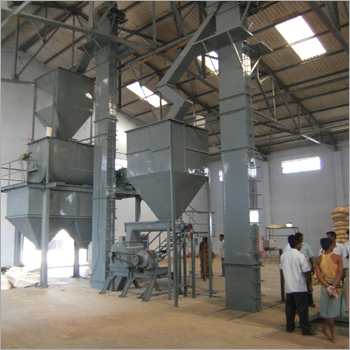
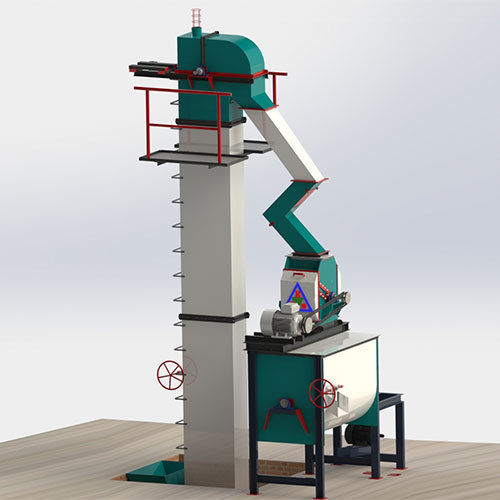
Fostered with a team of highly experienced professionals, we are offering our clients a superior quality Poultry Feed Mill that is suitable for milling purpose. This mill is widely used for processing of cattle and poultry feed. The offered mill is manufactured with high level of precision using excellent grade components with the help of cutting-edge technology. Owing to its simple operation and longer functional life, this Poultry Feed Mill is highly demanded in the market.
Feature :
-
High capacity and low energy consumption
-
The plant is compact, occupies less floor space
-
Can produce both poultry & livestock feed
-
Easily Adjustable and superb quality
-
All machines can be interlocked and safe
-
Poultry Feed Mill -20 Ton /Hour With Batching Scale
Why Our Poultry Feed Milling Plant?
Applications:
- Used in Conveyors, Grinders, Pellet Machines, Mixer Machines, Sieve, Coolers
Specifications:
Model | SZLH250 | SZLH320 | SZLH350 | SZLH400 | SZLH420 | SZLH508 |
Main Motor Power (kw) | 22 | 37 | 55 | 90 | 110 | 160 |
Conditioner Power (kw) | 1.5 | 2.2 | 2.2 | 3 | 5.5 | 7.5 |
Diameter of mould (mm) | 250 | 320 | 350 | 400 | 420 | 508 |
Feeder Power (kw) | 0.75 | 1.5 | 1.5 | 1.5 | 1.5 | 2.2 |
Size of Finished pellets (mm) | 1.5-18 | 1.5-18 | 1.5-18 | 1.5-18 | 1.5-18 | 1.5-18 |
Yeild (t/h) | 1-2 | 2-4 | 2-6 | 3-8 | 4-12 | 4-18 |
Advanced Feeding MechanismThe feed mill utilizes automatic or screw feeder systems to streamline the process of delivering raw materials into the milling chamber. This ensures uniform distribution and optimal grinding, which directly improves feed consistency and quality. Coupling this mechanism with durable construction increases operational efficiency and reduces downtime.
Customizable Capacity and PerformanceDesigned to suit a variety of operational scales, this feed mill offers a broad capacity range from 500 kg/hour to 2 TPH. Users can select specific configurations and motor power between 10 HP and 50 HP according to their production needs, ensuring both energy efficiency and scalability for expanding businesses.
FAQs of Poultry Feed Mill:
Q: How does the automatic or screw feeder improve poultry feed production?
A: The automatic or screw feeder system ensures a steady and controlled flow of ingredients into the milling chamber, reducing manual intervention. This results in consistent feed texture, minimal wastage, and greater efficiency during production.
Q: What is the process for customizing the feed mills capacity and color?
A: Customization is straightforward. Customers can specify the required production capacity (between 500 kg/hr and 2 TPH) and choose either the standard industrial green finish or request a preferred color. Manufacturers tailor the machinery and aesthetics to individual customer needs at the time of order.
Q: When is the feed mill most beneficial for poultry operations?
A: The feed mill is especially beneficial during periods of increased feed demand, such as flock expansion or seasonal growth. Its high-capacity range and automation features support uninterrupted production, ensuring poultry have adequate nutrition at all times.
Q: Where is this feed mill manufactured and exported from?
A: This poultry feed mill is manufactured in India by experienced suppliers and exporters, offering top-grade equipment to both domestic and international clients.
Q: What advantages does the mild steel construction provide?
A: Mild steel offers excellent durability, corrosion resistance, and structural integrity, making the feed mill suitable for intensive use and extending its operational life in challenging industrial environments.
Q: How is the feed mill installed and operated at the facility?
A: Installation typically involves connecting the system to a compatible power source (220-440 V, 50/60 Hz) and securing the unit at the desired location. Once installed, operators can set the feeder type and start automated processing. Training and user manuals are provided by the supplier.
Q: What benefit does the voltage range offer to various users?
A: The wide voltage range (220-440 V) allows the feed mill to operate in locations with different power infrastructures. This flexibility makes it suitable for both small-scale farms and larger commercial ventures.






 English
 Spanish
 French
 German
 Italian
 Chinese (Simplified)
 Japanese
 Korean
 Arabic
 Portuguese




 Send Inquiry

 Send Inquiry
 Send SMS
 Call Me Free